
Reviewed by Dr. Suprabath H. N., Consultant Fetal Medicine Specialist, 2026-11-12
This article is general information and does not replace advice from your obstetrician.
Double marker test in pregnancy, in short
The double marker test in pregnancy (also called the dual marker test) is a blood test, done between 11 weeks and 13 weeks 6 days, that measures two substances, free beta-hCG and PAPP-A, to estimate the chance of a chromosomal condition such as Down syndrome or Edwards syndrome. It is a screening test, not a diagnosis. In large studies, about 95 in 100 results come back low-risk, with roughly 5 percent flagged for a closer look (ACOG data, summarised below).
A low-risk result makes a chromosomal condition unlikely but does not rule it out. This guide walks through the report line by line, so the numbers make sense before your next maternity and pregnancy care visit.
When is the double marker test done, and why 11 to 13 weeks?
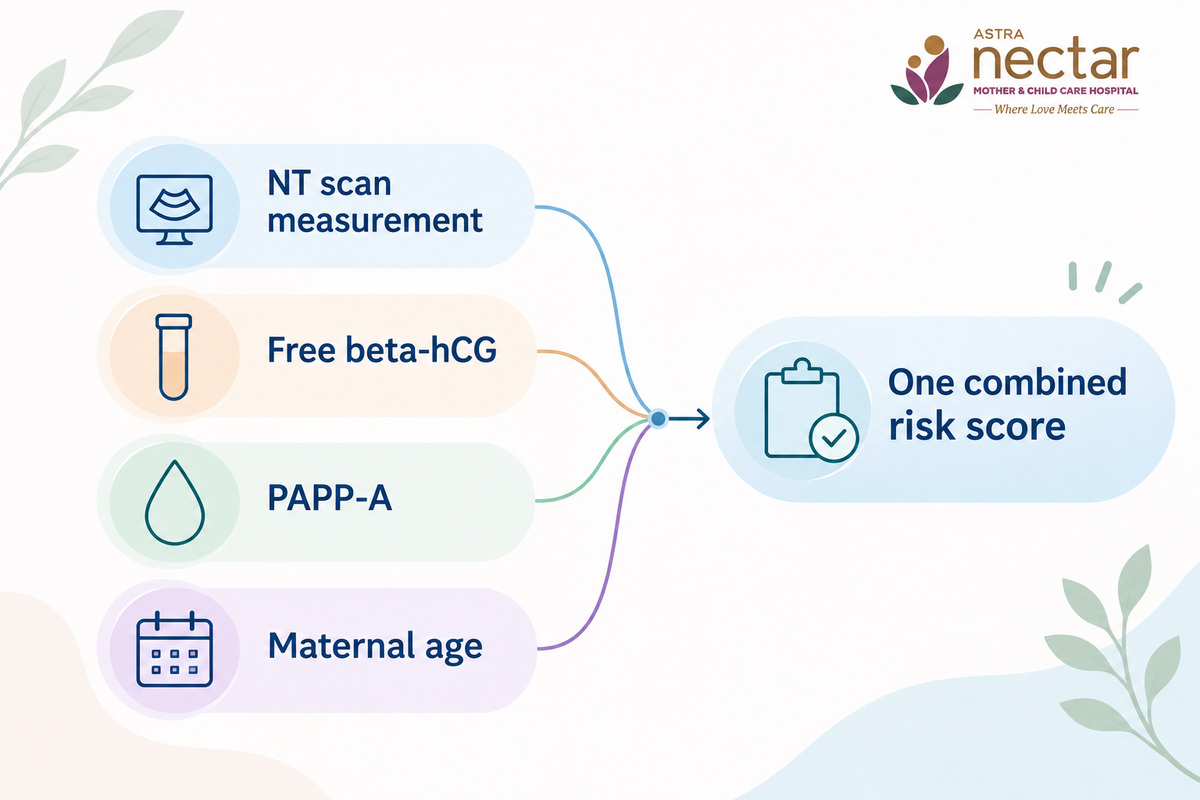
The double marker test is done from 11 weeks to 13 weeks 6 days of pregnancy, usually on the same visit as the NT scan. The NT scan is an ultrasound measurement of the fluid at the back of your baby’s neck, and it can only be measured reliably in this window. The scan result and the two blood markers go into one combined risk calculation, which is more accurate than either alone.
The double marker test is the earlier of the two major screening checks in antenatal care. The second is the anomaly scan (TIFFA) at 18 to 22 weeks.
If the window has been missed, the quadruple marker test is the second-trimester equivalent.
| Test | When | Markers |
|---|---|---|
| Double marker test | 11 weeks to 13 weeks 6 days (first trimester) | Free beta-hCG and PAPP-A, combined with the NT scan |
| Quadruple marker test | 15 to 20 weeks (second trimester) | Four blood markers |
The quadruple test is covered in the FAQ below.
How to prepare for your double marker test
No fasting or special preparation is needed. The one thing that matters is bringing accurate pregnancy dates.
Do you need to fast?
No. The blood draw does not need fasting, so eat and drink normally. If your appointment letter says something different, follow the letter.
What to bring
Bring these to your double marker test:
- Your obstetrician’s referral or your antenatal file
- The date of your last menstrual period (LMP) or your dating scan report
- Any earlier scan reports
Accurate dates matter more than they seem: your marker levels are compared against the average for your exact gestational age, so a dating error of even a week can shift the calculated risk.
What happens on the day
The visit has up to three steps:
- A standard blood draw, which takes a few minutes.
- The NT scan, if it is booked for the same visit.
- A wait in reception for your partner or family member. In line with the PCPNDT Act, 1994, no attender is allowed inside the scanning room for any ultrasound scan.
Beyond the needle, there is no discomfort.
What the double marker test screens for
The double marker test estimates a probability, a figure such as 1 in 1,000, that a pregnancy has a chromosomal condition. The two it is mainly designed to flag are Trisomy 21 (Down syndrome) and Trisomy 18 (Edwards syndrome). Some reports also include Trisomy 13 (Patau syndrome).
The lab measures free beta-hCG and PAPP-A in your blood. Software then combines those two levels with the NT scan measurement, your age and your gestational age into a single risk figure.
In pregnancies affected by Down syndrome, free beta-hCG tends to run higher than average and PAPP-A lower, which is why the pattern across both markers is read together.
How well does it work? The American College of Obstetricians and Gynecologists’ 2007 practice bulletin, as summarised in American Family Physician, puts the Down syndrome detection rate of combined first-trimester screening (NT measurement, PAPP-A and free beta-hCG) at 82 to 87 percent when 5 percent of results are classed screen-positive. Combined first-trimester screening is used in antenatal care around the world to identify who may benefit from further testing.
Understanding your double marker test report
Every double marker report prints two marker values as MoM, one combined risk ratio, and a low-risk or high-risk label set against the lab’s cut-off. Each term is explained below.
| Term | What it means |
|---|---|
| Free beta-hCG | A pregnancy hormone. Your level is compared with the expected range for your exact gestational week and printed as a MoM value. |
| PAPP-A (Pregnancy-Associated Plasma Protein-A) | A protein made by the placenta, measured in the PAPP-A test in pregnancy. Also printed as a MoM value. |
| MoM (Multiples of the Median) | Your level as a ratio to the average for your gestational week. A MoM of 1.0 is exactly average. The specialist reads the pattern across both markers. |
| Risk ratio (for example, 1:250) | The calculated probability written as a fraction. A result of 1:1500 means roughly a 1-in-1500 chance. A larger second number means a lower risk. |
| Cut-off (1:250 at Nectar) | The threshold your risk ratio is measured against to label the result low risk or high risk. Nectar’s reports use 1:250; other labs may use a different cut-off, for example 1:300. |
| Low risk / screen negative | Your risk is lower than the lab’s cut-off. For example, 1:1000 is lower risk than a 1:250 cut-off. A low-risk result makes a chromosomal condition unlikely but does not rule it out, and your obstetrician will tell you whether anything else is needed. |
| High risk / screen positive | Your risk is higher than the lab’s cut-off. For example, 1:100 is higher risk than a 1:250 cut-off. Your specialist will discuss a more accurate follow-up test. |
People often search for a “double marker normal range”, but the result that matters is the combined risk ratio, not either marker alone. As a rough guide, a MoM value up to about 1.5 is generally considered normal, and because this is a blood test, each lab prints its own reference range on the report, which your specialist can check with the lab. One marker outside the range does not by itself make the result high-risk.
Labs use slightly different cut-offs and layouts, so bring the report to your obstetrician, who reads it alongside the rest of your pregnancy. The growth scan later in pregnancy is read the same way: see our guide to the growth scan report.
What if your result comes back high-risk?
Most high-risk results are not a chromosomal condition. A cut-off of 1:250 means a result sitting exactly at the cut-off still has 249 chances in 250 that the baby is unaffected. The test is built to be sensitive, catching more potential cases and accepting some false alarms.
The higher your risk figure, for example 1:20 compared with 1:200, the more useful a follow-up test becomes. A flagged result means the next step is a more accurate test.
Depending on your numbers and the NT measurement, your specialist may offer:
- A detailed discussion with your obstetrician or fetal medicine specialist about your specific numbers.
- NIPT (Non-Invasive Prenatal Testing), a more accurate blood-based screening test that can be done from 10 weeks. NIPT is still a screening test, so a high-risk NIPT result should be confirmed with CVS or amniocentesis before any decision is made.
- A diagnostic test, if indicated: chorionic villus sampling (CVS), usually at 11 to 14 weeks, or amniocentesis, usually after 16 weeks. Either can confirm a diagnosis directly, and your specialist will explain the small risks of these procedures before you decide.
At Nectar, fetal medicine, paediatric cardiology and paediatric neurology are on the same campus, so a flagged result is followed through in one place.
Questions worth taking to your specialist: What was my NT measurement? Which cut-off was my report measured against? Do my numbers point to NIPT or straight to a diagnostic test?
Book your double marker test & NT scan at Nectar
Frequently asked questions
Is the double marker test the same as the NT scan?
No, but they are usually done together. The NT scan is an ultrasound measurement of the fluid at the back of the baby’s neck. The double marker test is a blood test measuring free beta-hCG and PAPP-A.
Combined, they give a more accurate risk than either alone, which is why the two are usually booked for the same visit between 11 and 13 weeks 6 days. A fetal medicine team can tell you which tests suit your dates.
Do I need to fast before the double marker test?
No fasting is needed for the double marker test. It is a standard blood draw that takes a few minutes, so eat and drink normally on the day. The only preparation is bringing your LMP date or dating scan report, which is needed to calculate your exact gestational age.
What is the difference between the double marker test and the quadruple (or triple) marker test?
They screen for similar chromosomal conditions at different points in pregnancy. The double marker test is a first-trimester test (11 weeks to 13 weeks 6 days) that measures two markers.
The quadruple marker test is a second-trimester option (15 to 20 weeks) that measures four, used when the first-trimester window was missed. The triple marker test is an older second-trimester version that measures three of those four markers (hCG, AFP and unconjugated estriol); the quadruple test adds inhibin A. Each test suits its own timing.
What does a risk ratio like “1:250” on my report mean?
It is the calculated probability written as a fraction: 1:250 means an estimated 1-in-250 chance of the condition being screened for. Your report compares it with a cut-off, which is 1:250 at Nectar and can differ at other labs, to label the result low risk or high risk. A larger second number means a lower risk.
My report says “high risk”. Does that mean my baby has Down syndrome?
No. High risk, or screen positive, means your risk is higher than the lab’s cut-off, and most high-risk results do not turn out to be a chromosomal condition. At a 1:250 cut-off, even a result sitting exactly at the threshold leaves 249 chances in 250 that the baby is unaffected. It is a prompt to discuss further testing.
A fetal medicine specialist can explain what your number means and whether NIPT or a diagnostic test makes sense next.
When will I get my double marker test results?
The double marker report’s turnaround depends on the laboratory processing the sample, because the test needs specialised biochemical analysis rather than a rapid in-house test.
Our team will tell you the expected date when you book.
Do I need this test if my pregnancy is low-risk and healthy?
The double marker test is recommended for every pregnancy, not only higher-risk ones, and is offered between 11 weeks and 13 weeks 6 days. First-trimester screening, or its second-trimester equivalent, is offered to all pregnant women because how well you feel day to day does not predict the chromosomal screening result. Whether to have it is your choice, made with your obstetrician.
Will the double marker test tell me my baby’s sex?
No. This test screens for chromosomal conditions only and reveals nothing about sex. Under India’s PCPNDT Act, 1994, disclosing the sex of the fetus at any stage of pregnancy is illegal at every ultrasound and diagnostic clinic in the country.
Our team is legally required not to share it, at any scan or test.
Book your double marker test at Nectar

At our Kanakapura Road campus in South Bangalore, the double marker test and NT scan are read together by our in-house fetal medicine specialist, Dr. Suprabath H. N., with paediatric sub-specialty support on the same campus if it is ever needed. To book, call our helpline at +91 94800 20202 or use the booking form below.
Already have a double marker report from another lab? Call our helpline at +91 94800 20202 and book a consultation with our fetal medicine team, and they can review it with you during your OPD appointment.