

Reviewed by Dr. Suprabath H. N., Consultant Fetal Medicine Specialist — 2026-10-01
Anomaly scan (TIFFA), in short
The anomaly scan, also called the TIFFA scan (Targeted Imaging for Fetal Anomalies), is the detailed ultrasound done between 18 and 22 weeks of pregnancy to check your baby’s anatomical development: the brain, spine, heart, kidneys and limbs, along with growth, placental position and amniotic fluid. It takes 30–45 minutes, needs no fasting or full bladder, and for most families ends with the words every parent is listening for: nothing out of the ordinary. This guide covers how to prepare, what happens in the room, what the specialist is checking, and how to read the report you’ll take home.
When is the anomaly scan done at 20 weeks — and why 18–22 weeks?
Your baby’s organs have grown large enough by 18 weeks to be seen clearly on ultrasound, and are still small enough to fit into a single, systematic scan view. It’s also early enough that if the scan finds something needing a closer look, there’s still time for clinical decisions to be made calmly rather than urgently.
If your obstetrician scheduled your scan a little earlier or later than this window, that isn’t a problem. It happens for all sorts of reasons: your specific pregnancy, a delay in booking, or how your dates worked out. It only changes what the scan can see clearly at that point, and your obstetrician has factored that in.
How to prepare for your anomaly scan (TIFFA scan preparation)
There’s very little to do before an anomaly scan: no fasting, and usually no full bladder. Here’s exactly what to expect.
Do you need to fast before the anomaly scan?
No fasting needed. Eat and drink as you normally would before your scan.
Should you drink water beforehand?
A full bladder isn’t required for this scan. It isn’t required for the early dating scan either — that scan is usually done as a transvaginal scan (TVS), which doesn’t need a full bladder. By 18–22 weeks your baby is easily seen on the anomaly scan without it.
What to wear
Comfortable two-piece clothing you can lift or loosen at the abdomen without having to change. A loose top with leggings or trousers works well. You’ll be lying down for most of the scan with gel applied to your belly.
What to bring
Your obstetrician’s referral note, your early pregnancy/dating scan report, your NT scan report (if you had one), your double marker test or NIPT report (if you had one), a list of any medications you’re currently taking, your health-insurance details if you’re routing the visit through cover, and a piece of fruit or some juice in case the specialist needs you to step out and change position partway through.
Can your partner come with you?
No. Under the PCPNDT Act, 1994 — a government rule applied at every ultrasound clinic in the country, not something specific to Nectar — no attender is allowed inside the scanning room during the scan itself. Your partner or family member is welcome to wait in our reception area.
How long does the anomaly scan take?
Plan for 30–45 minutes for the scan itself, plus 15–20 minutes for reception and settling in. If your baby is lying in a position that makes certain views difficult, the specialist may ask you to step out, walk around for a while, and have a piece of fruit or some juice; this often encourages a change of position. The specialist will call you back in when it’s time to check again. It adds to the length of your visit. It doesn’t affect what the scan can see.
What happens during the anomaly scan procedure
You’ll lie back, and ultrasound gel is applied to your abdomen. The specialist moves a probe across your belly while watching a screen, capturing measurements and images as they go. You may be asked to shift position slightly, take a few breaths, or walk around briefly if your baby isn’t cooperating with a particular view.
The specialist is working through a structured checklist: system by system through your baby’s anatomy, each measurement against the expected range for your exact gestational age, and blood flow through the placenta. There are stretches where they go quiet. That’s concentration, not concern. A full findings summary comes at the end.
What the anomaly scan checks for
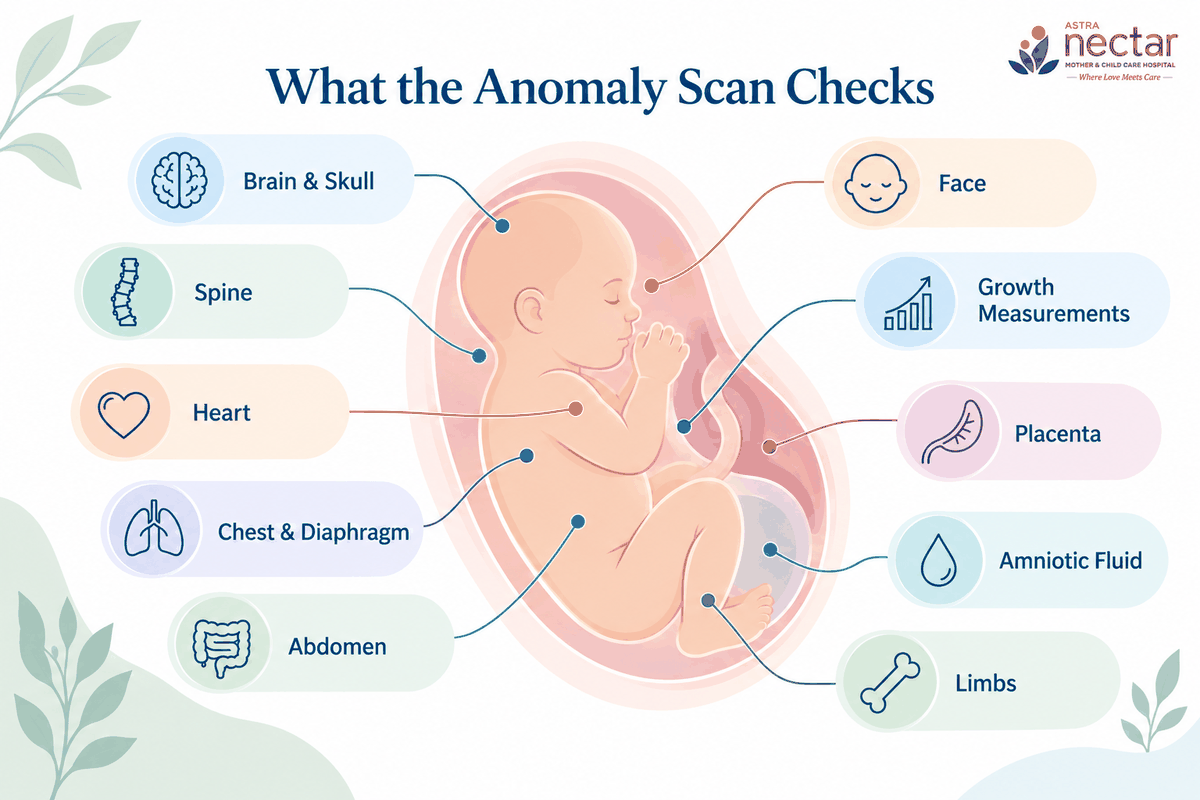
The specialist works through ten areas in a fixed order:
- Brain and skull — brain structures, the fluid-filled ventricles inside the brain, skull shape
- Spine — the full length of the spine, checked for any openings
- Face — lips and palate, eye sockets, nasal bone
- Heart — all four chambers, the major vessels leaving the heart, and blood flow direction
- Chest and diaphragm — lung development and an intact diaphragm
- Abdomen — stomach, kidneys, bladder, and the abdominal wall
- Limbs — arms, legs, hands, and feet, both presence and length
- Placenta — its location (including whether it’s sitting low), thickness, and blood flow
- Amniotic fluid — the volume of fluid surrounding your baby
- Growth — head circumference, abdominal circumference, femur length, and an estimated weight
Every ultrasound has limits, and no single scan sees everything with total certainty. If anything needs a closer look, the response is a targeted follow-up scan booked for a later date.
Anomaly scans at Nectar are done by an in-house fetal medicine specialist on the Kanakapura Road campus. Book an anomaly scan at Nectar
Understanding your anomaly scan report
Your report will carry a set of abbreviations and numbers that mean very little on first read. Here’s what they stand for, in plain terms:
| Term | What it means |
|---|---|
| HC — Head circumference | Measurement around your baby’s head, compared to the expected size for your gestational week |
| BPD — Biparietal diameter | Distance across your baby’s head, side to side |
| AC — Abdominal circumference | Measurement around your baby’s abdomen |
| FL — Femur length | Length of the thigh bone; used with the others to track growth |
| EFW — Estimated fetal weight | A calculated figure derived from the measurements above, not a direct weighing |
| AFI — Amniotic fluid index | The volume of fluid around your baby, measured in centimetres |
| Placenta location | Described as anterior, posterior, fundal, or low-lying |
| Cervical length | Measured in millimetres; a short cervix at this stage is a specific thing your obstetrician will want to know about |
| NAD | “No abnormality detected” — the phrase most parents are hoping to see; it means the specialist found nothing outside the expected range for this scan |
Your report leans heavily on these terms and on comparisons to your gestational week. If one number sits slightly outside a printed range but the specialist hasn’t flagged it as a concern, it’s usually within acceptable individual variation. Babies aren’t identical, and neither are their measurements. Bring the printed report to your next visit as part of your maternity and pregnancy care with your obstetrician; that conversation is where the numbers turn into meaning for your specific pregnancy.
What happens if the scan finds something?
Most anomaly scans are reassuringly normal. Where the specialist does flag something, they explain it to you in plain language in the room, before you leave.
What happens next depends on what’s found. It might be a repeat scan in two to four weeks; many “soft markers” resolve on their own as the pregnancy progresses. It might be a more targeted scan of one specific organ. Occasionally it means a consultation with a paediatric sub-specialty team, to understand what a finding could mean for care planning around a higher-risk pregnancy and for birth.
Having paediatric specialties on the same campus as the scan changes what happens next. When a finding needs a second opinion in cardiology, neurology, surgery, or neonatal intensive care, that conversation happens inside the same hospital, coordinated directly rather than referred out.
The purpose of the anomaly scan is to catch things early enough that decisions can still be made calmly. Being scanned is never itself a bad sign. It’s simply what good pregnancy care looks like at this stage.
Frequently asked questions
Do I need to fast before an anomaly scan?
No. Unlike some abdominal ultrasound scans, the anomaly scan doesn’t require fasting. Eat and drink as you normally would on the day. If you happen to have other tests scheduled the same day that do need fasting, follow that instruction; the anomaly scan itself works either way.
Do I need a full bladder for the anomaly scan?
No. The early dating scan around 6–8 weeks doesn’t need a full bladder either — it’s usually done as a transvaginal scan (TVS), which doesn’t require one. By 18–22 weeks, your baby is large enough to be seen clearly on the anomaly scan without it. Follow whatever your scan booking says; if it doesn’t mention bladder prep, there’s nothing to do about it.
How long does the anomaly scan take?
Around an hour door to door. The scan itself runs 30–45 minutes, with 15–20 minutes at reception before it. Awkward baby positions are the usual reason a scan runs long: you may be asked to step out, walk around, and have a snack while the baby shifts, then come back in to check again. This is standard practice and carries no clinical meaning.
Will you tell me the sex of my baby?
No. Under India’s PCPNDT Act, 1994, disclosing the sex of the foetus at any stage of pregnancy is illegal, and this applies to every ultrasound clinic in the country without exception. Every scan at Nectar is conducted strictly for medical purposes: checking your baby’s development, growth, and wellbeing. Please don’t ask; our team is legally required to decline.
What if the scan finds something?
Most scans are reassuringly normal. Where the specialist does find something, they explain it to you in plain language before you leave the room, and the same explanation goes into the written report. Next steps vary by finding: a repeat scan in a few weeks (many soft markers resolve on their own), a targeted scan of a specific organ, or a specialist consultation. Because paediatric cardiology, neurology, surgery, and a Level 3 NICU sit on the same campus, any specialist input can be coordinated directly rather than referred elsewhere.
Can my partner come with me?
No. Under the same PCPNDT Act referenced above, no attender is permitted inside the scanning room during any ultrasound scan — this is a nationwide rule, not a Nectar policy. Your partner or family member is welcome to wait in our reception area.
Do I need a referral to book an anomaly scan at Nectar?
No, a referral isn’t required. If you’re an antenatal patient at Nectar, the scan is already part of your antenatal plan. If you’re coming from another hospital, perhaps because it doesn’t have a fetal medicine specialist or you’d like a second opinion on an earlier scan, you can book directly with our fetal medicine team. Bring your obstetrician’s referral note if you have one, along with your earlier scans and reports and your obstetrician’s contact details, so we can share the findings with them.
When will I get the report?
The specialist gives you a verbal summary immediately after the scan. Your written report is usually ready within half an hour. If a finding needs further review or a second opinion, that may take a little longer; the specialist will tell you at the time.
Book your anomaly scan at Nectar
Anomaly scans at Nectar are performed by our in-house fetal medicine specialist, Dr. Suprabath H. N., with obstetric, paediatric and neonatology follow-up available on the same campus if anything needs it. To book, call our helpline at +91 94800 20202 or use the booking form on the fetal medicine page.

Already have your anomaly scan report from elsewhere and want a second read? Call our helpline at +91 94800 20202 to have it reviewed by our fetal medicine specialist.